|
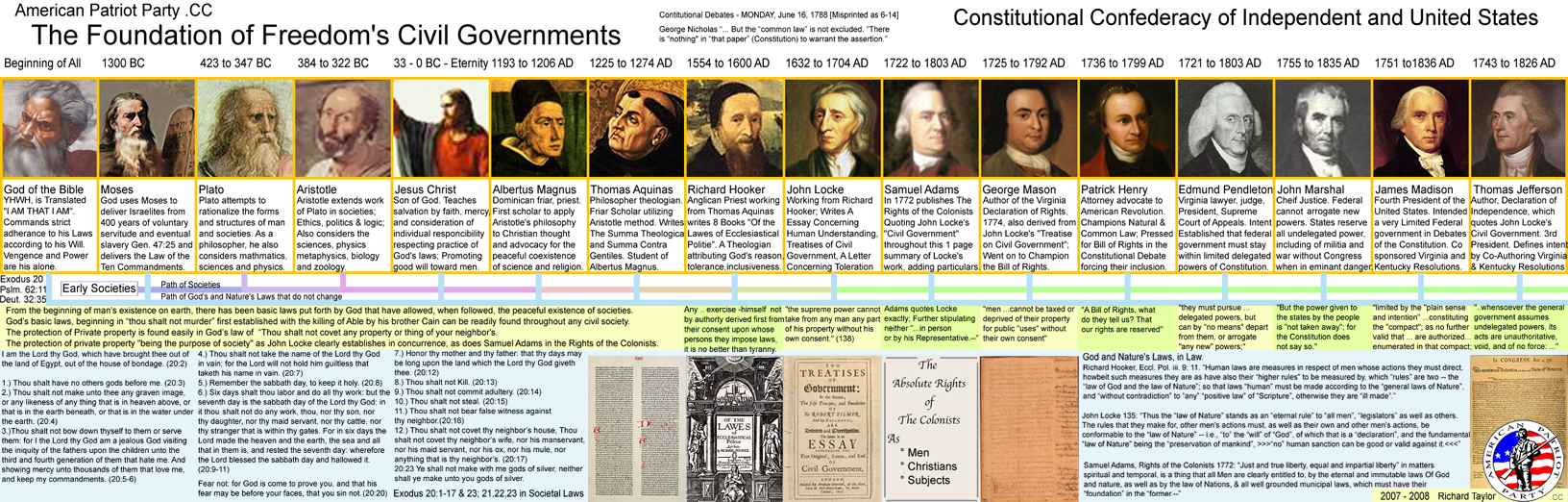
Please note graph typo correction made on this graph from older version if you have copied it; The word under John Marshal was "Cannot abrogate new powers" and has been corrected in this graph to read "cannot arrogate any new powers" Please replace with corrected version. To all State Chair Persons and Party Members:
This is the second issue of the American Patriot Party National News Letter. In this issue we will be examining the fundamental foundations and reasoning to liberty and freedom, the need to abide by them, and the dangers inherent of venturing outside those fundamental principles, definitions and practices.
The rich history offered presents an interesting examination of freedom and liberty that you may not be aware of;
A history that establishes the long chain of events that eventually developed into the free society we have today.
Our government representatives, and people from other countries that wish to have the blessings of freedom, may wish to consider what it is that makes freedom free, and the understanding of what is and what makes liberty.
Sincerely,
Richard Taylor
Chair
American Patriot Party (.CC)
American Patriot Party of Oregon
Index
1.) History of Freedom and Liberty in the Making
If the reader is not acquainted with John Locke, he is the man whose "Essay Concerning The True Original, Extent, and End of Civil Government, in 1689" (which see notations there), provided the foundations that our free society is based upon, and all but writing the Rights of the Colonists given to us by Samuel Adams ; This as Samuel Adams quoted John Locke throughout that document in numerous areas either word for word or in summarizing John Locke's Essay works which had been written some 82 years earlier.
John Locke also established the context of liberty that was drawn from by Thomas Jefferson to lay the groundworks of the Declaration of Independence and "the terms" on which the Declaration of separation was grounded;
Our summary would be incomplete not to include (Judicious) Richard Hooker (March 1554 November 3, 1600), whose extensive works studied by John Locke, had outlined toleration and inclusiveness defined in his Lawes of Ecclesiastical Politie. Which massive works are free to download in .pdf format; Richard Hooker considerably influenced the development of Anglicanism. He was the co-founder (with Thomas Cranmer and Matthew Parker) of Anglican theological thought. It is easy to draw from his works the reasoning grasped by John Locke and Samuel Adams and all the founders of our free country and civil government.
Further study will find that Richard Hooker studied (Saint) Thomas Aquinas 1272 Who studied Aristotle (a student of Plato) as well as the Bible and teachings of Christ, and a prominent theologian of the Catholic Church. The works Thomas Aquinas is best-known are the Summa Theologica and the Summa Contra Gentiles; Thomas Aquinas mentor was Albertus Magnus, also known as Saint Albert the Great and Albert of Cologne who in 1254 Albertus was made provincial of the Dominican Order; Albertus Magnus was the first among medieval scholars to apply Aristotle's philosophy to Christian thought; A Dominican friar and priest achieving fame for his comprehensive knowledge of and advocacy for the peaceful coexistence of science and religion; Considered a great German philosopher and theologian of the Middle Ages. The lineage of men that established the practice of "Toleration" between church and church, church and man and church and state while retaining basic principles of God's law, God's reason and God's nature in the construction of Christian civil societies and their freedom based governments. These clarifications given are to be defined in the following.
I would recommend reading John Locke's Essay Concerning "The True Original, Extent, and End of Civil Government" 1689. It is this brief document that sets the foundations for defining liberty and freedom as understood by the founders. We have highlighted those contributions that are clearly seen within the Rights of the Colonists, Declaration of Independence and other documents related to, on that page.
The Essay is reasonably short and takes only about about an hour or two to read....
You will, after starting, wish to study it longer and refer back to it as It is a rich document that underlines freedom and liberty's core and established foundations.
2.) Protection of Private Property is the End Purpose of Civil Government
There are some individual powers established by our founders that you will note by reading "The Absolute Rights of the Colonists", one being that neither person or representative are able to take private property without the individuals consent;
This is consistent with Locke's statement that property that can be taken by government or legislative without the consent of the person who owns the property would be as if the person would have no ownership in the property at all.
John Locke 137. Absolute arbitrary power, or governing without settled standing laws, can neither of them consist with the ends of society and government, which men would not quit the freedom of the state of Nature for, and tie themselves up under, were it not to preserve their lives, liberties, and fortunes, and by stated rules of right and property to secure their peace and quiet. It cannot be supposed that they should intend, had they a power so to do, to give any one or more an absolute arbitrary power over their persons and estates, and put a force into the magistrate's hand to execute his unlimited will arbitrarily upon them; this were to put themselves into a worse condition than the state of Nature, wherein they had a liberty to defend their right against the injuries of others, and were upon equal terms of force to maintain it, whether invaded by a single man or many in combination. Whereas by supposing they have given up themselves to the absolute arbitrary power and will of a legislator, they have disarmed themselves, and armed him to make a prey of them when he pleases; he being in a much worse condition that is exposed to the arbitrary power of one man who has the command of a hundred thousand than he that is exposed to the arbitrary power of a hundred thousand single men, nobody being secure, that his will who has such a command is better than that of other men, though his force be a hundred thousand times stronger. And, therefore, whatever form the commonwealth is under, the ruling power ought to govern by declared and received laws, and not by extemporary dictates and undetermined resolutions, for then mankind will be in a far worse condition than in the state of Nature if they shall have armed one or a few men with the joint power of a multitude, to force them to obey at pleasure the exorbitant and unlimited decrees of their sudden thoughts, or unrestrained, and till that moment, unknown wills, without having any measures set down which may guide and justify their actions. For all the power the government has, being only for the good of the society, as it ought not to be arbitrary and at pleasure, so it ought to be exercised by established and promulgated laws, that both the people may know their duty, and be safe and secure within the limits of the law, and the rulers, too, kept within their due bounds, and not be tempted by the power they have in their hands to employ it to purposes, and by such measures as they would not have known, and own not willingly."
John Locke 138. Thirdly, the supreme power cannot take from "any man any part of his property" "without his own consent". (APP Note: See these exact words in the Rights of the Colonists) For the preservation of "property" being the "end of government", and that for which men enter into society, it necessarily supposes and requires that the people should have property, without which they must be supposed to lose that by entering into society which was the "end for which they entered into it"; "too gross an absurdity for any man to own". Men, therefore, in society having property, they have such a right to the goods, which by the law of the community are theirs, that nobody hath a right to take them, or any part of them, from them without their "own" consent; without this they have "no property at all".
For I have truly no property in that which another can by right take from me when he pleases against my consent.
Hence it is a "mistake" to think that the "supreme or legislative power" of "any commonwealth" can do what it will, and dispose of the estates of the subject arbitrarily, or take any part of them at pleasure. This is not much to be feared in governments where the legislative consists wholly or in part in assemblies which are variable, whose members upon the dissolution of the assembly are subjects under the common laws of their country, equally with the rest. But in governments where the legislative is in one lasting assembly, always in being, or in one man as in absolute monarchies, there is "danger still", that they will think themselves to have a distinct interest from the rest of the community, and so will be apt to increase their own riches and power by taking what they think fit from the people. For a man's property is not at all secure, though there be good and equitable laws to set the bounds of it between him and his fellow-subjects, if he who commands those subjects have power to take from any private man what part he pleases of his property, and use and dispose of it as he >>> thinks good."
Where any individual or collective, including federal, state, city corporation, or other, deems they should have a right to an individuals property, or his rights; whatever they may be; they should prove that they in part and as a whole must be willing to first risk, or be, or have, removed willingly as much rights from themselves and their properties to accomplish the same end so as to make such an attempt void and unfruitful;
Or else purchase a freely consented and willingly granted "use" of such a person's rights they wish to utilize, by that person's free and consensual offer of license for such use, while protecting that person's right to his rights or properties; before attempting to take them through condemnation; Which no one or more persons have a power to do in a free country; Which they themselves have entered into society for the same such protection of their own rights.
3.) Just Compensation is Not a License to Condemn
This did not change in the Constitution with the words "without just compensation"; Where one may attempt to do so without justification against the true intent of the Founders;
This because when you read the Constitutional debates, that clause was a war powers and criminal act within the finite and very limited delegated powers of the federal government, and not an excuse for either the local cities, counties, states or federal government to condemn or take lands by just compensation for its own or other parties causes which are not directly for the purpose of protecting that persons property from being taken.
This is because the sole purpose of civil government is to protect an individual's right to property.
I will repeat this because this is so important to understand.
The Purpose of Just Compensation is only to be used to protect that, or those properties under ownership of the individual being compensated, this should there be an attack upon "it";
It is not an excuse to subvert the purpose of protecting that property of the individual, and take it, whether in person, persons or representatives, for purposes they may think good.
Taking property and justly compensating a person for the use to protect his property can never be thought to be for the purpose of condemning without a person's willing consent; and, or keeping the property for personal or public use without that person's "willing" "consent".
This is whether or not it is "thought" to be as a "betterment" of society, as this would be the same as the person having no property at all. The "betterment" of society should never be confused with the first law of protecting society, when there is no danger to society present that directly "endangers the preservation" of society, which is for the sole purpose of protecting an individuals property;
This is because, one is for the taking for what another "thinks" is good for their perceived purposes, against the willing consent he who possesses a right to that property;
The other is for protecting the right of the person to be secure in his person against such attacks.
This is why "neither" person or legislative representative, as clearly outlined by both John Locke and Samuel Adams can ever be supposed to take a person's property without his willing consent; Or to create "designs" by which to take the property by other means.
Constitution Amendment V: No person shall be held to answer for a capital, or otherwise infamous crime, unless on a presentment or indictment of a Grand Jury, except in cases arising in the land or naval forces, or in the Militia, when in actual service in time of War or public danger; nor shall any person be subject for the same offense to be twice put in jeopardy of life or limb; nor shall be compelled in any criminal case to be a witness against himself, nor be deprived of life, liberty, or property, without due process of "law"; nor shall private property be taken for public "use", without "just compensation".
To loose life, liberty or property, one must be criminal to loose (even that is limited in the subject of property), or else taking would be "ARBITRARY".
The "subject" of this amendment is referring to criminal offenses, "not" simple public will for public projects or other. Just compensation was also originally limited to the 10 square miles of Washington, DC; and without authority of the "original compact" changed after the civil war to be used within the states as with "imminent domain".
Samuel Adams - Rights of the Colonists: "...In short it is the greatest absurdity to suppose it in the power of one or any number of men at the entering into society, to renounce their essential natural rights, or the means of preserving those rights when the great end of civil government from the very nature of its institution is for the support, protection and defence of those very rights: the principal of which as is before observed, are life liberty and "property.
John Locke: 138: (Compare) "...For the preservation of "property" being the "end of government", and that for which men enter into society, it necessarily supposes and requires that the people should have property, without which they must be "supposed to lose" that by entering into society which was the "end for which they entered into it"; "too gross an absurdity for any man to own".
JUST COMPENSATION FOR PUBLIC "USE", >>> IS "TEMPORARY".
IT IS NOT CONDEMNATION INTO ANOTHER PARTY'S OWNERSHIP! It can NEVER be considered a power to TAKE PERMENATELY.
The Constitution is for national causes to provide for the "general welfare", which is defined by the founders as "military protection against foreign invasion", or protection against invasion of one state against another at the request of the state being attacked.
It is for the "protection" of private property, "not" for endangerment of a subjects property or excuse to condemn; Nor can the states claim any such unintentional power from any state constitution.
Constitutional Debates - MONDAY, June 16, 1788.[1] [Elliot misprinted this as Monday, June 14, 1788.] :
George Nicholas "... But the "common law" is not excluded.
"There is >>> nothing in "that paper" (APP Note: The US Constitution being debated) to warrant the assertion."
As shown, "common law" has not been voided by the Constitution;
What then does Common Law say about the taking of private property?:
John Locke 149. "....And thus the community perpetually retains a supreme power of saving themselves from the "attempts" and "designs" of "anybody", even of their "legislators", whenever they shall be so "foolish" or so "wicked" as to lay and carry on "designs" against the liberties and "properties" of the subject. For no man or society of men having a power to deliver up their preservation, or consequently the means of it, to the absolute will and arbitrary "dominion" of another, whenever any one shall go about to bring them into such a slavish condition, they will always have a right to preserve what they have not a power to part with, and to "rid" themselves of "those" who invade this fundamental, sacred, and unalterable law of self-preservation "for which" they "entered" into "society". ..."
Rights of the Colonists 1772: Thirdly, The supreme power (i.e. Legislative) >>>cannot "Justly" take from "any man", "any part" of his "property">>> without his "consent", >>> in person >>>or by his "Representative".--
John Locke (1689) 138. Thirdly, the supreme power cannot take from "any man any part of his property" "without his own consent". (APP Note: See these exact words in the Rights of the Colonists)
For the preservation of "property" being the "end of government", and that for which men enter into society, it necessarily supposes and requires that the people should have property, without which they must be "supposed to lose" that by entering into society which was the "end for which they entered into it"; "too gross an absurdity for any man to own".
Men, therefore, in society having property, they have such a right to the goods, which by the law of the community are theirs, that "nobody" hath a right to take them, or "any part" of them, from them without their "own" "consent"; without this they have "no property at all".
For I have truly no property in that which another can >>>"by right" take from me when he pleases "against my consent".
Hence it is a "MISTAKE" to "think" that the "supreme or legislative power" of "ANY commonwealth" can do what it will, and dispose of the estates of the subject arbitrarily, >>>or TAKE >>>ANY PART of them at pleasure.
4.) Limits to Powers of Societies Against the Properties of the Individual
There is a limit to where any person or collective, whether community or legislative, attempts to deem they should have a right to an individuals property or to an individuals rights;
The person or collective should prove that they, in part or as a whole, must have no other way to obtain that which they feel is needed, with the same loss to the ownership of their own properties; and be willing to first risk or be or have removed willingly as much rights from their selves and their properties to accomplish the same end; A absurdity to such end that they cannot for themselves give up any more than the person they wish to take the property from.
Leaving anyone then who wishes use of an individuals property with only the offer to purchase a "willing consensual use" granted to them by the "individual" on a annual, or continual license granted to them under the sole dictates of and by the individual who owns the property so to benefit that individual during any contract, perpetually or until such time he is willing to sell; Thereby protecting that person's right to his rights or properties removing any "legal" attempt to take them through condemnation; Which those who desire someone else's property have entered society for the protection from such condemnation of their own rights and properties from others who would attempt the same.
"Condemnation" of property or rights being a clear arbitrary act against any right or property, and a subversion to the "purpose of society" which is to protect against any such acts of condemnation.
176. That the aggressor, who puts himself into the state of war with another, and unjustly invades another man's right, can, by such an unjust war, "never come to have a right over the conquered", will be easily agreed by all men, who will not think that robbers and pirates have a right of empire over whomsoever they have force enough to master, or that men are bound by promises which unlawful force extorts from them. Should a robber break into my house, and, with a dagger at my throat, make me seal deeds to convey my estate to him, would this give him any title? Just such a title by his sword has an unjust conqueror who forces me into submission. The injury and the crime is equal, whether committed by the wearer of a crown or some petty villain. The title of the offender and the number of his followers make no difference in the offence, unless it be to aggravate it. The only difference is, great robbers punish little ones to keep them in their obedience; but the great ones are rewarded with laurels and triumphs, because they are too big for the weak hands of justice in this world, and have the power in their own possession which should punish offenders. What is my remedy against a robber that so broke into my house? Appeal to the law for justice. But perhaps justice is denied, or I am crippled and cannot stir; robbed, and have not the means to do it. If God has taken away all means of seeking remedy, there is nothing left but patience. But my son, when able, may seek the relief of the law, which I am denied; he or his son may renew his appeal till he recover his right. But the conquered, or their children, have no court -- no arbitrator on earth to appeal to. Then they may appeal, as Jephtha did, to Heaven, and repeat their appeal till they have recovered the native right of their ancestors, which was to have such a legislative over them as the majority should approve and freely acquiesce in. If it be objected this would cause endless trouble, I answer, no more than justice does, where she lies open to all that appeal to her. He that troubles his neighbour without a cause is punished for it by the justice of the court he appeals to. And he that appeals to Heaven must be sure he has right on his side, and a right, too, that is worth the trouble and cost of the appeal, as he will answer at a tribunal that cannot be deceived, and will be sure to retribute to every one according to the mischiefs he hath created to his fellow-subjects -- that is, any part of mankind. From whence it is plain that he that conquers in an unjust war can thereby have no title to the subjection and obedience of the conquered.
This is clear as to unjustly taking of property without ones willing consent.
Rights of the Colonists 1772: Thirdly, The supreme power (i.e. Legislative) >>>cannot "Justly" take from "any man", "any part" of his "property">>> without his "consent", >>> in person >>>or by his "Representative".--
Not even by his representative.
This removes the power of any legislative to take, or condemn.
5.) True Purpose and Intent of "Just Compensation"
The reason for which this clause in the constitution was placed, is clearly defined in the Constitutional Debates where the British army would take land without the willing consent of either the individual or the local society.
Constitutional Debate:
MONDAY, June 16, 1788.[1] [Elliot misprinted this as Monday, June 14, 1788.]
Patrick Henry: If Congress shall say that the general welfare requires it, they may keep armies continually on foot. There is no control on Congress in raising or stationing them (APP Speaking of the Constitution being debated). They may billet them on the people at pleasure. This unlimited authority is a most dangerous power: its principles are despotic. If it be unbounded, it must lead to despotism; for the power of a people in a free government is supposed to be "paramount" to the existing power.
".... "Advert to the power thoroughly." One of our first complaints, under the former government, was the quartering of troops upon us. This was one of the principal reasons for dissolving the connection with Great Britain. Here (APP Note: Speaking of the Constitution being Debated) we may have troops in time of peace. They may be billeted in any manner to tyrannize, oppress, and crush us.
George Mason warns of mis-interpretation by the Federal Government
Mr. GEORGE MASON asked to what purpose the laws were read. The objection was, that too much power was given to Congress power that would finally destroy the state governments more effectually by insidious, underhanded means, than such as could be openly practiced. This, said he, is the opinion of many worthy men, not only in this Convention, but in all parts of America."
"...Now, suppose oppressions {442} should arise under "this" government, and any writer should dare to stand forth, and expose to the community at large the abuses of "those" powers; could not Congress, under the "idea" of providing for the general welfare, and under their "own" construction, say that this was destroying the "general peace", encouraging sedition, and poisoning the minds of the people? And could they not, in order to provide against this, lay a dangerous restriction On the press? Might they not even bring the trial of this restriction within the ten miles square, when there is no prohibition against it? Might they not thus destroy the trial by jury? Would they not extend their implication? It appears to me that they may and "will". And shall the support of our rights depend on the bounty of men "whose interest it may be to oppress us"? That Congress should have power to provide for the "general" welfare of the Union, I grant. But I wish a clause in the Constitution, with respect to all powers which are not granted, that they are "retained by the states".
Otherwise, the power of providing for the "general welfare" may be "perverted to its destruction".
.... Unless there be some express declaration that every thing not given is retained, it will be carried to any power Congress may please."
Important APP Note: This "general welfare" described by George Mason, is explained in the Constitutional debates as a limited military federal protection against armed foreign invasion, or, protection by other states to be secure from invasion by other states, but in this last case, only at the request of that state.
The "Perversion" he speaks of, is the federal government using the term broadly and outside that very limited definition.
Mr. GEORGE MASON "still thought that there ought to be some express declaration in the Constitution, asserting that rights not given to the general government were retained by the states. He apprehended that, unless this was done, many valuable and important rights would be concluded to be given up by implication." ... "that "artful sophistry and evasions could not satisfy him". He could see no clear distinction between rights relinquished by a positive grant, and lost by implication. Unless there were a bill of rights, implication might "swallow up all our rights".
James Madison Warns of the Dangers of the Federal Government broadly interpreting the limited delegated powers.
"If that "latitude of construction" which he (Patrick Henry warned) contends for were to take place with respect to the sweeping clause, there "would be" room for "those horrors". But it gives "no" supplementary power. It only enables them to execute the "delegated" powers.
For when any power is given, its delegation necessarily involves authority (APP: authority derived from the "original compact") to make laws to execute it."
This is clear to establish that, if a power is not delegated to the federal government, the federal government, or the legislative of it, they cannot even contemplate it.
6.) Government's Misuse of General "Terms" and "Words"
Thomas Jefferson and James Madison warn against the federal government misusing "terms" and "words" within the Constitution to expand the powers of the federal government beyond its limited delegated powers.
Here is a very interesting event in history where the "intent" of the founders are clearly established.
James Madison, having had great optimism in the Constitution, is placed in a position to have to realize the dangers that Patrick Henry and George Mason warned of; Having them coming true during John Adam's presidential reign.
The Alien and Sedition acts and other attempts of federal powers result in James Madison leaving the Federalists and joining Thomas Jefferson and the "Democratic Republicans" in writing the Virginia and Kentucky Resolutions.
Here, "pay special attention" to what they are saying about the federal government misusing and exploiting what were "general" "TERMS" and "WORDS" in the Constitutions language to grasp at powers that were not delegated to the federal government by the Constitution:
Virginia Resolution of 1798:
Thomas Jefferson and James Madison: "...That this Assembly doth explicitly and peremptorily declare, that it views the powers of the federal government, as resulting from the compact, to which the states are parties; as limited by the "plain sense and intention" of the instrument constituting the "compact"; as no further valid that they are authorized by the grants "enumerated" in that compact; and that in case of a deliberate, palpable, and dangerous exercise of other powers, not granted by the said compact, the states who are parties thereto, have the right, and are in duty bound, to interpose for arresting the progress of the "evil", and for maintaining within their respective limits, the authorities, rights and liberties appertaining to them.
That the General Assembly doth also express its deep regret, that a spirit has in sundry instances, been manifested by the federal government, to "enlarge its powers" by "forced constructions" of the constitutional charter which defines them; and that implications have appeared of a "design" to expound certain general "phrases" (which having been copied from the very limited grant of power, in the former articles of confederation were the less liable to be misconstrued) so as to destroy the meaning and effect, of the particular "enumeration" which necessarily explains and limits the "general phrases"; and so as to consolidate the states by degrees, into "one sovereignty", the obvious tendency and inevitable consequence of which would be, to "transform" the present republican system of the United States, into an absolute, or at best a mixed monarchy.
So here we have clear intention of those who wrote our Declaration of Independence and created our Constitution, and these intentions clearly establish that we are:
1.) Not "one Nation" as through federal propaganda attempts, but 50 independent nation states that are in full control of a very limited and subordinate federal government with very limited "delegated" powers it cannot exceed what so ever.
2.) Presented also here by Thomas Jefferson and James Madison is that the Misusing general PHRASES in an attempt to CONSOLIDATE the states into ONE SOVEREIGNTY, is an ACT of "EVIL" which is clearly against the intent of the founders and against the intent of the Constitution itself.
3.) Further, it changes the original intent of the legislative when it was created. And this, when it occurs, as clearly established by John Locke 227, (see below following insert) Automatically Dissolves the Legislative and the government that was formed under the consent of the people who formed it; As does occur when the standing legislature established to protect the people and their properties gives the people up to a foreign power....
It looses all authority, and the people of that legislature, are as individuals with no authority,
The citizens, and each individual, are then without any government (Locke 220), and fully within the state of nature for which all may choose and construct a new legislative and government to their own choosing without references of states or other constructs from the original compact that was dissolved.
Therefor least the states maintain full legislative powers over the federal government and keep it within its delegated powers, all governments, county, state and federal, loose all authority and put themselves into a state of war with the people.
Kentucky Resolution of 1798
Thomas Jefferson and James Madison: 1. Resolved, That the several States composing, the United States of America, are not united on the principle of unlimited submission to their general government; but that, by a compact under the style and title of a Constitution for the United States, and of amendments thereto, they constituted a general government for "special purposes" — delegated to that government certain definite powers, reserving, each State to itself, the residuary mass of right to their own self-government; and that whensoever the general government assumes undelegated powers, its acts are "unauthoritative", "void", and of "no force": that to this compact each State acceded as a State, and is an integral part, its co-States forming, as to itself, the other party: that the government created by this compact was not made the exclusive or final judge of the extent of the powers delegated to itself; since that would have made "its" discretion, and not "the Constitution", the measure of its powers; but that, as in all other cases of compact among powers having no common judge, each party has an equal right to judge for itself, as well of infractions as of the mode and measure of redress.
"the powers not delegated to the United States by the Constitution, our prohibited by it to the States, are reserved to the States respectively, or to the people"; and that "no" power over the freedom of religion, freedom of speech, or freedom of the press being delegated to the United States by the Constitution, nor prohibited by it to the States, all lawful powers respecting the same did of right remain, and were reserved to the States or the people:
7. Resolved, That the construction applied by the General Government (as is evidenced by sundry of their proceedings) to those parts of the Constitution of the United States which delegate to Congress a power "to lay and collect taxes, duties, imports, and excises, to pay the debts, and provide for the common defense and "general welfare" of the United States," and "to make all laws which shall be necessary and proper for carrying into execution, the powers "vested" by the Constitution in the government of the United States, or in any department or officer thereof," goes to the destruction of all limits prescribed to their powers by the Constitution: that >>>"words" meant by the instrument to be subsidiary "only" to the execution of "limited powers", "ought not to be so construed" as themselves to give unlimited powers, nor a part to be so taken as to destroy the whole residue of that instrument: that the proceedings of the General Government under color of these articles, will be a fit and necessary subject of revisal and correction, at a time of greater tranquillity, while those specified in the preceding resolutions call for immediate redress..
8th. "...that in cases of an abuse of the delegated powers, the members of the general government, being chosen by the people, a change by the people would be the constitutional remedy; but, where powers are assumed which have not been delegated, a "nullification of the act is the rightful remedy": that every State has a natural right in cases not within the compact, (casus non fœderis) to "nullify" of their "own authority" all assumptions of power by others within their limits: that without this right, they would be under the dominion, absolute and unlimited, of whosoever might exercise this right of judgment for them: that nevertheless, this commonwealth, from motives of regard and respect for its co States, has wished to communicate with them on the subject: that with them alone it is proper to communicate, they alone being parties to the compact, and "solely authorized to judge" in the "last resort of the powers exercised under it",
Congress being "not a party", but "merely" the creature of the compact, and subject as to its assumptions of power to the final judgment of "those by whom", and "for" "whose" use itself and its powers were all created and modified: ..."
If you did not catch the meaning of these last sentences, we will exploit the meaning, so that it is not passed by.
It clearly establishes that the "States" outside the legislative powers of the federal government have the power of oversight to insure the actions of those empowered by the compact; or what is here described as the US Constitution.
This is a governor, state legislative, local county and people power and duty - outside of the federal legislative, to insure the proper operation of the US Constitution and limit the federal government to its very limited "delegated" powers.
This power of the states and people is clearly described by James Madison and George Nicholas as they clearly establish this intention and fact in the Constitutional Debates:
Constitutional Debates:
MONDAY, June 16, 1788.[1] [Elliot misprinted this as Monday, June 14, 1788.]
James Madison: "... An observation fell from a gentleman, on the same side with myself, which deserves to be attended to.*** If we be dissatisfied with the national government, if we "should choose to renounce {415} it", "this is an additional safeguard to our defence"
George Nicholas: "...He then proceeded thus: But, says he, who is to determine the extent of such powers? I say, the same power which, in all well-regulated communities, determines the "extent" of "legislative" powers. If they exceed these powers, the judiciary will declare it void, or else "the people" will have a "right" to "declare it" " void"
If the federal legislature exceeds it's delegated powers, it is void.
7.) Common Law Rights Reserved
and Not Effected By the Constitution
The establishing of the basic fundamentals of liberty and freedom, through foundations in common natural law, being transferred, without diminishment of individual rights, into the foundations of the United States, the State Constitutions and the US Constitution, are clear in the founder's written intents:
Constitutional Debates - MONDAY, June 16, 1788.[1] [Elliot misprinted this as Monday, June 14, 1788.] :
To Patrick Henry's favor to the continuation of "common law", these statements establish it remains today:
George Nicholas: "... But why were the articles of the bill of rights read? Let him show us that those rights are given up by the Constitution. Let him prove them to be violated."
George Nicholas "... But the "common law" is not excluded. There is >>> nothing in "that paper" (APP Note: The US Constitution being debated) to warrant the assertion."
Patrick Henry: "....When fortified with full, adequate, and abundant representation, was she satisfied with that representation? No. She most cautiously and guardedly reserved and secured those invaluable, inestimable rights and privileges, which no people, inspired with the least glow of patriotic liberty, ever did, >>>or ever can, abandon."
"A bill of rights may be summed up in a few words. What do they tell us? That our rights are reserved."
8.) Freedoms and Liberties Defined Often we find freedom and liberty mislabeled;
How often have you heard the media present that freedom or liberty "can mean many things to many people"; And for things that are within the perimeters of the "actual definition", this would be true;
However, when things are removed outside of the "actual definition", to do "whatever one lists", it becomes "a falsehood"; and a dangerous precedence to allow to be set where both liberty and freedom are concerned. We will present two quotes which define "liberty". These quotes are from John Locke and Thomas Jefferson.
Thomas Jefferson:
"Rightful liberty is unobstructed action according to our will within "limits" drawn around us by the equal "rights" of others. I do not add 'within the limits of the law', because law is often but the tyrant's will, and always so when it violates the "rights" of the individual~~"
John Locke:
59. This holds in all the laws a man is under, whether natural or civil. Is a man under the law of Nature? What made him free of that law? what gave him a free disposing of his property, according to his own will, within the compass of that law? I answer, an estate wherein he might be supposed capable to "know" "that law", that so he might keep his actions "within the bounds of it". When he has acquired that state, he is presumed to know how far that law is to be his guide, and how far he may make use of his freedom, and so comes to have it;
63. The freedom then of man, and liberty of acting according to his own will, is grounded on his having "reason", which is able to instruct him in that law he is to govern himself by, and make him know how far he is left to the freedom of his own will.
Jefferson's quote "seems" to grant greater degree, but this would be an incomplete observation, it is only because there are things that Jefferson takes for granted that most Americans are not aware of and are not educated in; and these are the "laws of God and Nature", common law, defining "those natural" "rights" Jefferson is speaking of; and "liberties", which in "natural law" are defined "as" the "basis" "for" and the ability "to" that "reason" spoke of.
Jefferson is speaking of arbitrary laws with regard to tyrants; and his statement on rightful liberties and equal rights is that of "natural law" or "The Law of Nature" which defines those "inalienable rights and liberties" that are "defined" rights and liberties.
Here there is no contradiction because one does not give up completely the law of nature when he enters free society, as established by John Locke, but retains it as with others. Society only being a means to protect all persons within that society and their rights, liberties and properties.
9.) Law of Nature, Civil Society and the Original Compact
This is explained by John Locke and is more clearly summarized by Samuel Adams in the Rights of the Colonists:
Samuel Adams - Rights of the Colonists:
All Men have a Right to remain in a State of Nature as long as they please: And in case of intolerable Oppression, Civil or Religious, to leave the Society they belong to, and enter into another.--
When Men enter into Society, it is by voluntary consent; and they have a right to demand and insist upon the performance of such conditions, And previous limitations as form an equitable "original compact".--
Every natural Right not "expressly" given up or from the nature of a Social Compact "necessarily" ceded "remains".--
"In the "state" of nature, every man is under God, Judge and sole Judge, of his own rights and the injuries done him:
By entering into society, he "agrees to an Arbiter" or "indifferent Judge" between him and his neighbours;
but he no more renounces his "original right", than by taking a cause out of the ordinary course of law,"
Here is how John Locke describes it:
John Locke 131. "But "though" men when they enter into society give up the equality, liberty, and executive power they had in the "state" of Nature into the hands of the society, to be "so far" disposed of by the legislative as the good of the society shall require, yet it being "only" "with an intention" in every one the better to preserve himself, his liberty and property (for no rational creature can be supposed to change his condition with an intention to be worse), the power of the society or legislative constituted by them can never be supposed to extend farther than the common good, but is obliged to secure every one's property "by providing against those three defects" above mentioned that made the state of Nature so unsafe and uneasy.
(APP: See Locke with regard to the three defects of the "state" of nature)
And so, whoever has the legislative or supreme power of any commonwealth, is bound to govern by established standing laws, "promulgated" and known to the people, and not by extemporary decrees, by indifferent and upright judges, who are to decide controversies by those laws; and to employ the force of the community at home only in the execution of such laws, or abroad to prevent or redress foreign injuries and secure the community from inroads and invasion. And all this to be directed to no other end but the peace, safety, and public good of the people."
10.) Stepping from the "State" of Nature,
into Society which respects the "Law" of Nature
The state of nature is where each man is free to fend for himself.
The state of nature becomes dangerous when there are those who disregard the rights of others.
John Locke presents it this way:
John Locke 128. For in the state of Nature to omit the liberty he has of innocent delights, a man has two powers. The first is to do whatsoever he thinks fit for the preservation of himself and others within the permission of the law of Nature; by which law, common to them all, he and all the rest of mankind are one community, make up one society distinct from all other creatures, and "were it not for the corruption and viciousness" of "degenerate men", there would be no need of any other, no necessity that men should separate from this great and natural community, and associate into lesser combinations. The other power a man has in the state of Nature is the power to punish the crimes committed against that law. Both these he gives up when he joins in a private, if I may so call it, or particular political society, and incorporates into any commonwealth separate from the rest of mankind.
John Locke 129. The first power- viz., of doing whatsoever he thought fit for the preservation of himself and the rest of mankind, he gives up to be regulated by laws made by the society, so far forth as the preservation of himself and the rest of that society shall require; which laws of the society in many things confine the liberty he had by the law of Nature.
John Locke 130. Secondly, the power of punishing he wholly gives up, and engages his natural force, which he might before employ in the execution of the law of Nature, by his own single authority, as he thought fit, to assist the executive power of the society as the law thereof shall require. For being now in a new state, wherein he is to enjoy many conveniencies from the labour, assistance, and society of others in the same community, as well as protection from its whole strength, he is to part also with as much of his natural liberty, in providing for himself, as the good, prosperity, and safety of the society shall require, which is not only necessary but just, since the other members of the society do the like.
11.) The First Foundation of Freedom and Liberty
Now some may say we are going into religion, and so we are, in so much as the subject pertains of natural law and freedom.
You may wish to review the historical chart at the top of the page if you haven't already.
We will show that, whether or not one believes in God of the Bible, or has a different religion to that of Judeo Christian; that the laws within that bible, correctly practiced, protect all men;
And that, those laws are the basis of freedom and liberty itself.
12.) God's Law and Reason in the Law of Nature;
Verses Solely Human Reason without reference to God's Laws
It should be established clearly here, that there is a difference between "human reason" which is dictated entirely by man, without consideration to God or God's Law of Nature;
As opposed to, or in relation to "God's Law and Man's correct "reason" in relation, and in proper consideration, to God's Law";
A law and "reason" that has established basic unchanging foundations;
Which is very apparent and obvious as well, in nature; i.e. the Law of Nature.
We present this to clarify the "term" "reason", it having two meanings; and that the reader should note when he hears it used by others. Some churches rightfully opposing teaching reason because it is not based on or not in line with God's law; Should not oppose reason when it is, or not in conflict with it.
13.) God's Law is Freedom's Reason
Below are definitions that establish that "God's Law, God's Reason", "Common Law" - "Common Equity", "Positive Law", "Scripture", "Promulgated Laws", the "Law's of Nature", "Freedom" and "Liberty", the "rule" and "measure" of them all, are "one in the same":
a.) John Locke 8. "In transgressing the "law of Nature", the offender declares himself to live by another rule than that of "reason" and common equity, which is that "measure" "God" "has set" to the actions of men for their mutual security, and so he becomes dangerous to mankind;"
b.) John Locke 11. "...having renounced "reason", the common "rule and measure" "God" "hath given" to mankind,..."
c.) John Locke 13. "...I doubt not but it will be objected that it is unreasonable for men to be judges in their own cases, that self-love will make men partial to themselves and their friends; and, on the other side, ill-nature, passion, and revenge will carry them too far in punishing others, and hence nothing but confusion and disorder will follow, and that therefore God hath certainly appointed government to restrain the partiality and violence of men. I easily grant that civil government is the proper remedy for the inconveniences of the state of Nature, which must certainly be great where men may be judges in their own case, since it is easy to be imagined that he who was so unjust as to do his brother an injury will scarce be so just as to condemn himself for it."
d.) John Locke 135: "Thus the "law of Nature" stands as an "eternal rule" to "all men", "legislators" as well as others.
e.) Samuel Adams, Rights of the Colonists:
...As Christians: "These may be best understood by reading--and carefully studying the institutes of the great Lawgiver and head of the Christian Church: which are to be found clearly written and promulgated in the New Testament--"
The rules that they make for, other men's actions must, as well as their own and other men's actions, be conformable to the "law of Nature" -- i.e., "to" the "will" of "God", of which that is a "declaration", and the fundamental "law of Nature" being the "preservation of mankind", >>>"no" human sanction can be good or valid against it."
...As Men: ..."Just and true liberty, equal and impartial liberty" in matters spiritual and temporal, is a thing that all Men are clearly entitled to, by the eternal and immutable laws Of God and nature, as well as by the law of Nations, & all well grounded municipal laws, which must have their "foundation" in the "former.--"
f.) Richard Hooker, Eccl. Pol. iii. 9: 11. "Human laws are measures in respect of men whose actions they must direct, howbeit such measures they are as have also their "higher rules" to be measured by, which "rules" are two -- the "law of God and the law of Nature"; so that laws "human" must be made according to the "general laws of Nature", and "without contradiction" to "any" "positive law" of "Scripture", otherwise they are "ill made"."
g.) John Locke 6. But though this be a state of liberty, yet it is "not" a "state of licence"; though man in that state have an uncontrollable liberty to dispose of his person or possessions, yet he has not liberty to destroy himself, or so much as any creature in his possession, but where some "nobler use" than its bare preservation calls for it. The state of Nature has a law of Nature to "govern it", which "obliges every one", and "reason", which "is" that law, teaches all mankind who will but consult it, that being all equal and independent, no one ought to harm another in his life, health, liberty or possessions; for men being all the workmanship of one omnipotent and infinitely wise Maker; all the servants of one sovereign Master, sent into the world by His order and about His business; they are His property, whose workmanship they are made to last during His, not one another's pleasure.
h.) John Locke 21. Freedom, then, is "not" what Sir Robert Filmer tells us: "A liberty for every one to do what he lists, to live as he pleases, and not to be tied by any laws"; but freedom of men under government is to have a "standing rule" to live by, common to "every one" of that society, and made by the legislative power erected in it. A liberty to follow my own will in all things where that "rule" prescribes not, not to be subject to the inconstant, uncertain, unknown, arbitrary will of another man, as freedom of nature is to be under no other "restraint" >>>"but" the "law of Nature"."
i.) John Locke 57. " ...Could they be happier without it, the law, as a useless thing, would of itself vanish; and that ill deserves the name of confinement which hedges us in only from bogs and precipices. So that however it may be mistaken, the end of law is not to abolish or restrain, but to preserve and enlarge freedom. For in all the states of created beings, capable of laws, where there is "no law" "there is no freedom". For liberty is to be free from restraint (APP Note see Locke 21: "but from that of the Laws of Nature") and violence from others, which cannot be where there is no law; and is "not", as we are told, "a liberty for every man to do what he lists."
For who could be free, when every other man's humour might domineer over him? But a liberty to dispose and order freely as he lists his person, actions, possessions, and his whole property "within the allowance of those laws" under "which he is", and therein not to be subject to the "arbitrary will" of another, but freely follow his own."
APP Note: Locke 21, : His "own will" within the laws of Nature;
or Rights of the Colonists: "but only to have the "Law of Nature" for his "rule";
The Law of Nature clearly remaining today.
14.) Religions and Atheism
To illustrate the next segment regarding the absolute foundation of freedom and liberty and freedom's laws, we will take some extreme examples.
These two extremes will be first, Religions that are contrary to Judeo-Christian teaching, and second, Atheism, were man does not believe in the existence of a God.
Two extreme example for religions will be:
a.) Aztec belief in the Sun god which by religious practice may proclaim: "We shall draw lots for the sacrifice of a man to the sun god" or "he who volunteers shall be sacrificed and his voluntary sacrifice of his own life will be an honor to the people"
b.) Radical Islamic law which establishes that killing anyone who does not believe in Allah the way they believe in Allah;
One may also note that the old Catholics and Papists had the same bad habit when they proclaimed people as heretics;
Or to any of the religions, even the religions of atheism and humanism where they may relinquish the natural rights possessed of themselves, attack or accept the relinquishment of the defined natural rights of any individual.
John Locke covers this in his writings with regard to "Toleration" and his statements are repeated by Samuel Adams in the Absolute Rights of the Colonists, 1772:
John Locke Essay on Toleration: "...In the next place: As the magistrate has no power to impose by his laws the use of any rites and ceremonies in any Church, so neither has he any power to forbid the use of such rites and ceremonies as are already received, approved, and practiced by any Church; because, if he did so, he would destroy the Church itself: the end of whose institution is only to worship God with freedom after its own manner.
You will say, by this rule, if some congregations should have a mind to sacrifice infants, or (as the primitive Christians were falsely accused) lustfully pollute themselves in promiscuous uncleanness, or practice any other such "heinous enormities", is the magistrate obliged to tolerate them, because they are committed in a religious assembly? I answer: No. These things are "not lawful" in the "ordinary course of life", "nor in any private house"; and therefore "neither are they so in the worship of God, or in any religious meeting"."
Dictionary: enormity - enormities. 1. The quality of passing all moral bounds; excessive wickedness or outrageousness.
Samuel Adams, Rights of the Colonists, 1772
"If men through fear, fraud or mistake, should "in terms" renounce and give up any essential natural right, the eternal law of reason and the great end of society, would absolutely vacate such renunciation; the right to freedom being the gift of God Almighty, it is not in the power of Man to alienate this gift, and "voluntarily" become a slave."
This establishing that one cannot give up ones life or any essential natural right defined by God or Nature.
There are many examples of such religious extremism in many religions around the world. And in fact in the case of self voluntary sacrifice, radical Islam follows the ancient Aztec in blind adherence to their religion without regard for human life whose opinions differ.
Such a complete disregard for human life is prohibited by God and natures laws.
Voluntary slavery, slavery and involuntary servitude being prohibited; and toleration within reason; Therefore creating a barrier between any religion, or any person, organization or government that does not value human life, freedom and liberty as is defined by God's law i.e. the Law of Nature.
Two extreme examples of atheism will be:
c.) Atheist, who simply believe there is no God, who believe that man himself has and is in the power to control all things by his own will. .
d.) Humanists, who believe that man himself has and is in the power to control all things by his own will.
Where atheists and humanists may wish not to have God even mentioned at all and give all power to other atheist and humanists to control laws;
A example is when in their quest simply to deny the existence of God, finally get their way and deny him in all laws and matters;
When the Godless atheists and humanists having been given absolute power, turn upon those of them that gave them and have released that power;
They will ask "Why is it that those they gave powers to, have now the power to destroy and enslave them at their will?";
And those that have been given power will answer, "Because you gave us power to do so, and we have no limitations to any thing but our own will; We having no god but ourselves.
And therefor atheists, humanists and indeed often pacifists and anarchists, in given to releasing their rights and powers to other men (or any man) or removing all protections they would have had being a member in a Christian based Society, without limit and without reference to God and natures laws, find themselves at the mercy of the Godless, lawless and merciless.
John Locke 232. Whosoever uses force without right -- as every one does in society who does it without law -- puts himself into a state of war with those against whom he so uses it, and in that state all former ties are canceled, all other rights cease, and every one has a right to defend himself, and to resist the aggressor.
John Locke 8. "....In transgressing the law of Nature, the offender declares himself to live by another rule than that of reason and common equity, which is that measure God has set to the actions of men for their mutual security, and so he becomes dangerous to mankind;"
John Locke 57. ".... the end of law is not to abolish or restrain, but to preserve and enlarge "freedom". For in all the states of created beings, capable of laws, "where there is no law" "there is no freedom".
For "liberty" is to be free from restraint and violence from others, which cannot be where there is no law; and is not, as we are told, "a liberty for every man to do what he lists." For who could be free, when every other man's humour might domineer over him? But a liberty to dispose and order freely as he lists his person, actions, possessions, and his whole property >>>>>>>"within the allowance of those laws" under which he "is", and therein not to be subject to the arbitrary will of another, but freely follow his own.
Here we can clearly see, that by placing power into the hands of man, where man or men alone can dictate without any established Laws of Nature, i.e. God's laws as John Locke clearly establishes; We place ourselves at the mercy of men who find themselves in the position of such power, to do as they will to others, at their own dictates.
Constitutional Debates:
MONDAY, June 16, 1788.[1] [Elliot misprinted this as Monday, June 14, 1788.]
Patrick Henry: "... It must strike the mind of every gentleman. When our government was first instituted in Virginia, we declared the "common law" of England to be "in force".
That "system of law" which has been admired, and "has protected us and our ancestors"...
"...We are told, we are afraid to trust ourselves; that our own representatives Congress will not exercise their powers oppressively; that we shall not enslave ourselves; that the militia cannot enslave themselves,
Who has enslaved France, Spain, Germany, Turkey, and other countries which groan under tyranny?
They have been enslaved by the hands of their "own people".
If it will be so in America, it will be "only" as it "has been" "every where else"."
15.) Toleration in a Christian Based Society
The definition of Toleration, being necessary to understand the basis of a Christian based society which protects the freedoms and liberties of all men.
This is important to understand when some modern day "Libertarians" attempt to sell any opposing view to the original intent of the founders;
As aforementioned by John Locke in his assay on Civil government, Freedom and Liberty is "not" to do anything one lists:
John Locke 21. Freedom, then, is not what Sir Robert Filmer tells us: "A liberty for every one to do what he lists, to live as he pleases, and not to be tied by any laws"; but freedom of men "under government" is to have a "standing rule" to live by, common to "every one" of "that society", and made by the legislative power erected in it. A liberty to follow my own will in all things where that rule prescribes not, not to be subject to the inconstant, uncertain, unknown, arbitrary will of another man, as freedom of nature is to be under no other "restraint" >>>"but" the "law of Nature"."
John Locke 57. " ...Could they be happier without it, the law, as a useless thing, would of itself vanish; and that ill deserves the name of confinement which hedges us in only from bogs and precipices. So that however it may be mistaken, the end of law is not to abolish or restrain, "but to preserve and enlarge freedom".
For in all the states of created beings, capable of laws, where there is no law there is no freedom.
For liberty is to be free from restraint (APP Note see Locke 21: "but from that of the Laws of Nature") and violence from others, which cannot be where there is no law; and is not, as we are told, "a liberty for every man to do what he lists." For who could be free, when every other man's humour might domineer over him? But a liberty to dispose and order freely as he lists his person, actions, possessions, and his whole property within the allowance of those laws under "which he is", and therein not to be subject to the "arbitrary will" of another, but freely follow his own. (APP Note: His "own will" within the laws of Nature)
So there is a difference when man enters into society as above Locke describes: "but" "freedom of men under government"
Especially when he enters into a society that is based on Christian law to begin with, and long established as such.
16.) Promulgated Known Laws and Original Compact
Here it is emphasized promulgated, known laws, from a equitable original compact.
This being described in the Rights of the Colonists:
Samuel Adams, Rights of the Colonists:
As Christians--
"These may be best understood by reading--and carefully studying the institutes of the great Lawgiver and head of the Christian Church: which are to be found clearly written and promulgated in the New Testament--"
As Men:
When Men enter into Society, it is by voluntary consent; and they have a right to demand and insist upon the performance of such conditions, And "previous limitations" as "form" an "equitable" "original compact".--
Every natural Right not expressly given up or from the nature of a Social Compact necessarily ceded "remains".--
All positive and civil laws, should conform as far as possible, to the Law of natural reason and equity.--
As neither reason requires, nor religeon permits the contrary, every Man living in or out of a state of civil society, has a right peaceably and quietly to worship God according to the dictates of his conscience.--
"Just and true liberty, equal and impartial liberty" in matters spiritual and temporal, is a thing that all Men are clearly entitled to, by the eternal and immutable laws Of God and nature, as well as by the law of Nations, & all well grounded municipal laws, which must have their foundation in the former.--
As Subjects:
"The Legislative cannot Justly assume to itself a power to rule by extempore arbitrary decrees; but it is bound to see that Justice is dispensed, and that the rights of the subjects be decided, by "promulgated", standing and "known" laws, and authorized independent Judges;" that is independent as far as possible of Prince or People.
John Locke 136. "Secondly, the legislative or supreme authority cannot assume to itself a power to rule by extemporary arbitrary decrees, but is bound to dispense justice and decide the rights of the subject by promulgated standing laws, ..."
17.) Basis of Toleration
Here is the basis of toleration by and in a Christian based society:
Samuel Adams, Rights of the Colonists:
"...And it is now generally agreed among Christians that this spirit of toleration in the fullest extent consistent with the being of civil society "is the chief characteristical mark of the true church" & In so much that Mr. Lock has asserted, and proved beyond the possibility of contradiction on any solid ground, that such toleration ought to be extended to all whose doctrines are not subversive of society."
John Locke's definition of toleration from which Samuel Adams drew his principles from, is more pointed and explanatory, but says the same thing:
John Locke's Assay on Toleration: "Lastly, those are not at all to be tolerated who deny the being of a God. >>>Promises, covenants, and oaths, >>>which are the bonds of human society, >>>can have no hold upon an atheist. The taking away of God, though but even in thought, dissolves all; besides also, those that by their atheism "undermine and destroy" all religion, >>>can have no "pretence" of religion whereupon to challenge the "privilege" of a toleration. As for other practical opinions, though not absolutely free from all error, if they do not tend to establish domination over others, or civil impunity to the Church in which they are taught, there can be no reason why they should not be tolerated."
The clarification by John Locke as to the limit of that toleration is clearly noted.
The Privilege (of a toleration) therefor does "not" convey into a "Right" to do as one lists outside the laws of God and nature, that which is defined the foundations of a civil society, and then to proclaim protections granted of a toleration.
There are in fact limits to toleration as it being a "privilege" as well as those limits established in the Law of Nature and God's laws which we have earlier established, are one and the same.
Why toleration is a limited one, is for the protection of human life and civil society from those who are indifferent to the Law of Nature and of God's law that protect these established defined rights of a free society;
This defines our society from the "Original Compact" made as a Christian Based Society;
As it had been described in the Rights of the Colonists as "Christians"; From the historical foundations it was derived.
Such defined Rights and Laws, are which protect our lives, liberty and property from the unbridled practice of those who would use tyranny and oppression to enslave us.
18.) Limits of Toleration Include Government and Anyone
These limits of toleration apply to everyone, including the Legislative, the Executive and the Judicial.
Here John Locke explains "peace" is not an excuse to allow for governments or legislatures to oppress the people they have been instituted by the people to protect under the original compact.
And no toleration should be given of a government that attempts this.
John Locke (rules that establish when government removes itself from power)
John Locke 220: "...........To tell people they may provide for themselves by erecting a new legislative, when, by oppression, artifice, or >>>being delivered over to a foreign power, their old one is "gone", is only to tell them they may expect relief when it is too late, and the evil is past cure. This is, in effect, no more than to bid them first be slaves, and then to take care of their liberty, and, when their "chains are on", tell them they may "act" like free men. This, if barely so, is rather mockery than relief, and men can "never be secure from tyranny" if there be "no" "means" "to escape it" till they are perfectly "under it"; and, therefore, it is that "they have" not only a >>>>"right to get out of it", but to "prevent it"
|
----------- APP insert ------------
Related Subjects by John Locke's Essay on Toleration:
"Again: That Church can have no right to be tolerated by the magistrate which is constituted upon such a bottom that all those who enter into "it" do thereby ipso facto deliver themselves up to the "protection" and "service" of "another prince".
For by this means the magistrate would give way to the settling of a "foreign jurisdiction" in his "own country" and suffer his "own people" to be "listed" , as it were, for soldiers against his own Government."
APP - Important Note: Relate this "foreign jurisdiction" "in" his "own country" a transfer of power, service and employment of our citizens to the "United Nations" and other Foreign Controled Collectives, including Foreign Controlled Corporations operating within the United States or possessing foreign and international policing powers.
And also Relate "men can "never be secure from tyranny" if there be "no" "means" "to escape it"" to the
a.) Right to Bear Arms in the Second Amendment;
b.) 12th Greivance of the Declaration of Independence establishing the Civil Power is to be Greater in Power than the standing Army and
c.) James Madison's statement: "The highest number to which a standing army can be carried in any country does not exceed one hundredth part of the souls, or "one twenty-fifth part" of the number able to bear arms. This portion would not yield, in the United States, an army of more than twenty-five or thirty thousand men.
To these would be >>>"opposed" a "militia" amounting to near half a million >>>"citizens" with arms in their hands, "officered by men >>>chosen from "among themselves", fighting for "their" common liberties and united and conducted by governments possessing their affections and confidence (APP: Possessing the "citizens" affections, not the other way around - the reason for very localized county legislation that this statement attends to, and very local citizen powers).
It may well be doubted whether a militia thus circumstanced could ever be conquered by such a proportion of regular troops. (APP Note: The Real Reason we "Keep and Bear Arms" see 12th Grievance of the Declaration of Independence)
Besides the advantage of being armed, it forms a barrier against the enterprises of "ambition", more insurmountable than any which a simple government of any form can admit of.
The governments of Europe are afraid to trust the people with arms. If they did, the people would surely shake off the yoke of tyranny, as America did.
Let us not insult the free and gallant citizens of America with the suspicion that they would be less able to defend the rights of which they would be in actual possession than the debased subjects of arbitrary power would be to rescue theirs from the hands of their oppressors."
------------- End APP insert ------------- |
|
John Locke 227. In both the aforementioned cases, when either the legislative is changed, or the legislators "act" "contrary to the end" for "which they were constituted", "those who are" guilty are guilty of rebellion.
For if any one by force takes away the established legislative of any society, and the laws by them made, pursuant to their trust, he thereby takes away "the umpirage" which every one had consented to for a peaceable decision of all their controversies, and a bar to the state of war amongst them.
They who remove or change the legislative take away this decisive power, which nobody can have but by the appointment and consent of the people, and so destroying the authority which the people did, and nobody else can, set up, and introducing a power which the people hath not authorized, "actually introduce a state of war", which is that of "force without authority"; and thus by removing the legislative established by the society, in whose decisions the people acquiesced and united as to that of their own will, they untie the knot, and expose the people anew to the state of war. And if those, who by force take away the legislative, are rebels, the legislators themselves, as has been shown, can be "no less esteemed so", when they who were set up for the protection and preservation of the people, their "liberties" and "properties" shall by "force invade and endeavour" to "take them away";
and so they putting themselves into a state of war with those who made them the protectors and guardians of their peace, are properly, and with the greatest aggravation, rebellantes, rebels.
This Clearly establishes that our government (s) can by their actions be declared "Rebels" against the Citizens and against the laws of Freedom.
This means the term rebelion is not a title only to be worn upon any side opposing a standing power, but in these cases, is clearly worn upon the standing power itself.
19.) Peace is No Excuse to Conceal Injustice
John Locke (continued) 228. But if they who say it lays a foundation for rebellion mean that it may occasion civil wars or intestine broils to tell the people they are absolved from obedience when "illegal attempts" are made upon their liberties or properties, and may oppose the unlawful violence of those who were their magistrates when they invade their properties, contrary to the trust put in them,
and that, therefore, "this doctrine" is "not to be allowed", being 'so destructive to the "peace" of the world';
>>>they may as well say, upon the same ground, that honest men may not oppose robbers or pirates,
because this may occasion disorder or bloodshed. If any mischief come in such cases,
>>> it is "not" to be charged upon "him who defends his own right", but "on him" that "invades his neighbour's"."
If the innocent honest man must quietly quit all he has for "peace sake" to him who will lay violent hands upon it, I desire it may be considered what kind of a peace there will be in the world which consists only in violence and rapine,
and which is to be maintained only for the benefit of robbers and oppressors.
Who would not think it an admirable "peace" betwixt the mighty and the mean, when the lamb, without resistance, yielded his throat to be torn by the imperious wolf? ....
20.) Resolve to Arbitrary Laws Against the Original Compact
Thomas Jefferson in the Declaration of Independence describes this as he quotes John Locke preceding the separation from their government.
"...that, whenever any form of government becomes destructive of these ends, it is the right of the people to alter or to abolish it, and to institute a new government, laying its foundation on such principles, and organizing its powers in such form, as to them shall seem most likely to effect their safety and happiness....
"...But when a long train of abuses and usurpations, pursuing invariably the same object, evinces a design to reduce them under absolute despotism, it is their right, it is their duty, to throw off such government and to provide new guards for their future security."
Relate also John Locke's statement below "provide for their own safety and security,"
John Locke presents it further in this way:
John Locke 222. The reason why men enter into society is the preservation of their "property"; and the end while they choose and authorise a legislative is that there may be laws made, and rules set, as guards and fences to the properties of all the society, to limit the "power" and moderate the "dominion" of every part and member of the society.
For since it can never be supposed to be the will of the society that the legislative should have a power to destroy that which every one designs to secure by entering into society, and for which the people submitted themselves to legislators of their own making:
"whenever" the legislators endeavour to take away and destroy the "property" of the people, or to reduce them to slavery under arbitrary power, they put themselves into a "state of war with the people",
who are thereupon absolved from "any farther obedience", and are left to the common refuge which God hath provided for all men against force and violence. Whensoever, therefore, the legislative shall "transgress" this fundamental rule of society,
and either by ambition, fear, folly, or corruption,...
|
APP NOTE: See also John Locke's points here mentioned "either by ambition, fear, folly, or corruption" in regard to "government and Legislatures"; on the "flipside" in regard to the "citizen", in Samuel Adams Statement within the Rights of the Colonists, 1772: "If men through fear, fraud or mistake, should in terms renounce and give up any essential natural right, the eternal law of reason and the great end of society, would absolutely vacate such renunciation; the right to freedom being the gift of God Almighty, it is not in the power of Man to alienate this gift, and voluntarily become a slave." |
|
....endeavour to grasp themselves, or "put into the hands" of "any other",
|
APP NOTE: Relate "Any Other" to Undeligated Powers Granted to the United Nations or through Foreign Treaties that impose International Mandates upon the Independent States, and States upon the Counties. |
|
an absolute power over the lives, liberties, and estates of the people,
by this "breach of trust" they >>>"forfeit" the power the people had put into their hands for quite contrary ends,
and it devolves to "the people", who have a "right" to resume their "original liberty",
and by the establishment of a new legislative (such as they shall think fit), provide for their own safety and security, which is the "end" for which they are "in" "society."
21.) Removing Interpretation by Placing
Law into a Higher Power, Protects All Men
By accepting that the laws of God and Nature are out of reach of man's altercation and interpretation either by simple acceptance of the law, or by the plain obviousness of either the natural purpose, or good; There becomes no interpretation by man, no question, no manipulation to use them to the detriment of other men possessing the same rights;
They become inalienable rights, because they are founded in an established inalienable laws that man cannot change.
John Locke: 15. "To those that say there were never any men in the state of Nature, I will not oppose the authority of the judicious (Richard) Hooker (Eccl. Pol. i. 10), where he says, "the laws which have been hitherto mentioned" -- i.e., the laws of Nature -- "do bind men absolutely, even as they are men, although they have never any settled fellowship, never any solemn agreement amongst themselves what to do or not to do; but for as much as we are not by ourselves sufficient to furnish ourselves with competent store of things needful for such a life as our Nature doth desire, a life fit for the dignity of man, therefore to supply those defects and imperfections which are in us, as living single and solely by ourselves, we are naturally induced to seek communion and fellowship with others; this was the cause of men uniting themselves as first in politic societies." But I, moreover, affirm that all men are naturally in that state, and remain so till, by their own consents, they make themselves members of some politic society, and I doubt not, in the sequel of this discourse, to make it very clear."...
(see John Locke's "Essay Concerning The True Original, Extent, and End of Civil Government" for more.
Hooker, Eccl. Pol. iii. 9: 11. "Human laws are measures in respect of men whose actions they must direct, howbeit such measures they are as have also their higher rules to be measured by, which rules are two -- the law of God and the law of Nature; so that laws human must be made according to the "general laws of Nature", and without contradiction to any "positive law" of "Scripture", otherwise they are "ill" made."
22.) God's Dominion and Law over Life and Liberty
Locke presents God's dominion over man's life does not allow man to give up his own life except to save another or such other more noble cause.
John Locke 6. "...for men being all the workmanship of one omnipotent and infinitely wise Maker; all the servants of one sovereign Master, sent into the world by His order and about His business; they are His property, whose workmanship they are made to last during His, not one another's pleasure.
John Locke 6. But though this be a state of liberty, yet it is "not" a "state of licence"; though man in that state have an uncontrollable liberty to dispose of his person or possessions, yet he has not liberty to destroy himself, or so much as any creature in his possession, but where some "nobler use" than its bare preservation calls for it.
John Locke on Civil Government - Chapter 4: Of Slavery:
John Locke 21. Freedom, then, is "not" .... "A liberty for every one to do what he lists...
John Locke 135: "Thus the "law of Nature" stands as an "eternal rule" to "all men", "legislators" as well as others.
The rules that they make for, other men's actions must, as well as their own and other men's actions,
be "conformable" to the "law of Nature" -- i.e., "to" the "will" of "God",
of which that is a >>> "declaration",
and the fundamental "law of Nature" being the "preservation of mankind",
>>>"no" human sanction can be good or valid against it."
23.) No Law, No Freedom, Nor Liberty
John Locke 57. ".... the end of law is not to abolish or restrain, but to "preserve" and enlarge "freedom". For in all the states of created beings, capable of laws, "where there is no law" "there is no freedom".
For "liberty" is to be free from restraint and violence from others, which cannot be where there is no law; and is not, as we are told, "a liberty for every man to do what he lists." For who could be free, when every other man's humour might domineer over him? But a liberty to dispose and order freely as he lists his person, actions, possessions, and his whole property within the "allowance" of "those laws" under which he "is", and therein not to be subject to the arbitrary will of another, but freely follow his own.
This is important because "The Laws under which we are" is common law except where powers have been delegated to society. All other rights are reserved to the people.
Common Law means Law Common to everyone, Or the "Law of Nature", as previously presented by John Locke 135 and established in nature as God's law or will of God.
Constitutional Debates - MONDAY, June 16, 1788.[1] [Elliot misprinted this as Monday, June 14, 1788.] :
George Nicholas "... But the "common law" is not excluded.
"There is >>> nothing in "that paper" (APP Note: The US Constitution being debated) to warrant the assertion."
24.) Having Not the Power Over Ones Own Life,
One has Not the Power to Enslave Oneself to Others
Here is a major reason to place law out of the hands of man and into the hands of God by accepting rights and the laws of nature as inalienable:
John Locke 22. This freedom from absolute, arbitrary power is so necessary to, and closely joined with, a man's preservation, that he cannot part with it but by what "forfeits" his preservation and life together.
For a "man", "not" having the power of his own life, cannot by compact "or" his "own consent" "enslave himself" "to any one",
nor put himself under the absolute, arbitrary power of another to take away his life when he pleases.
Nobody can give more power than he has himself, and he that "cannot take away his own life" cannot give another power "over" it.
Indeed, having by his fault forfeited his own life by some act that deserves death, he to whom he has forfeited it may, when he has him in his power, delay to take it, and make use of him to his own service; and he does him no injury by it. For, whenever he finds the hardship of his slavery outweigh the value of his life, it is in his power, by resisting the will of his master, to draw on himself the death he desires.
John Locke 23. This is the perfect "condition" of slavery, which is nothing else but the state of war continued between a lawful conqueror and a captive, for if once compact enter between them, and make an "agreement" for a limited power on the one side, and obedience on the other, the state of war and slavery ceases as long as the compact endures;
for, as has been said, "no man" can by "agreement" pass over to another
that which he "hath" "not" "in himself" -- "a power over his own life."
Now lets review Samuel Adams in the Rights of the Colonists:
"If men through fear, fraud or mistake, should in "terms" renounce and give up any "essential natural right", the eternal law of reason and the great end of society, would absolutely vacate such renunciation; the right to freedom being the gift of God Almighty, it is not in the power of Man to alienate this gift, and voluntarily become a slave."
A perfect summary of John Locke's statement.
Here Patrick Henry's Speech: "Give me Liberty or give me death." clearly places this in perspective, and the liberty spoke of understood as a "defined liberty" of natural law.
Keep these in mind, because "liberty" spoke of is a defined one, and clearly indicated here is not one to do as one "lists".
25.) Local Legislatures, the Keystone to Liberty
As opposed to Distant Legislatures which see our American Patriot Party article, which the founders clearly illustrate there can be no real concern to the cares and needs of the people at distance;
The importance of very local legislatures is a check upon the misuse of distant powers even within a state, where population of one area can impose unwanted mandates upon another part of a state.
States, which in the original 13 colonies were mostly small ones, illustrate an example to follow in areas that can be considered to represent a community or "commonwealth" and even these broken up into counties for adequate representation.
A good example in our State of Oregon is when a bill was passed a few years ago to allow development of properties, the state was imposed upon by those in the North Part of the state to stop its allowance and redefine the bill, stating that the new bill proposed was actually what the voters wanted.
The southern part of the state objected with over 60% to stop the new bill which would again limit the sale and development of their properties. However, the Northern Part of the state, which possesses a higher population, forced the passage of the bill, against the will of the southern part of the state which desperately needs more industry.
The intent of the founders has always been to strengthen adequate representation of people's communities so that they and their properties were not placed under the arbitrary powers of others who have no other purpose but to control or to extract what they may with little care to the opinions of those they oppress.
Rights of the Colonists 1772
Samuel Adams: "...Now what liberty can there be, where property is taken away without "consent"? Can it be said with any colour of truth and Justice, that this Continent of three thousand miles in length, and a breadth as yet unexplored, in which however, its supposed, there are five millions of people, has the least voice, vote or influence in the decisions of the British Parliament?
Have they, all together, any more right or power to return a single member to that house of commons, who have not inadvertently, but deliberately assumed a power to dispose of their lives, Liberties and properties, than to choose an Emperor of China!
Had the Colonists a right to return members to the British parliament, it would only be hurtful; as from their local situation and circumstances it is "impossible" they should be ever truly and properly represented there.
The inhabitants of this country in all probability in a few years will be more numerous, than those of Great Britain and Ireland together; yet it is absurdly expected [Volume 5, Page 397] by the promoters of the present measures, that these, with their posterity to all generations, should be easy while their property, shall be disposed of by a house of commons at three thousand miles "distant" from them;
and who cannot be supposed to have the least care or concern for their real interest: Who have not only no natural care for their interest,
"but must be in effect >>> "bribed" against it"; as every "burden" they lay on the colonists is so much saved or gained to themselves. ..."
How relevant this is in the western states, or in reality, any state of which size establishes a distance where real understanding to the issues of any part of the community cannot be adequately represented.
Note that the "Colonists" had "Representatives" in the house of commons that did not share their interests, nor did the magistrates that lived among them when following the "mandates" of their "distant legislature".
The United States Federal government in fact Practices "bribing" states on a regular basis with tax money derived from the states;
This occurs regularly where in order for the states to get tax money already taken from them, back in the form of Highway maintenance funds, The state in exchange must follow environmental and other "federal mandated policies" to receive such money back, as if it was the Federal government's money and not the citizen's who paid it;
And more importantly, had paid it for the purposes the tax money was paid only, and not to be bribed further to get it back.
This practice by the federal, and indeed state government's acceptance of it, forces many policies which few, if any, are wished for by the many local communities that such "mandates" adversely effect.
On powers, where the federal government does not, and whose enumerated powers are not expressly delegated to, the state and local governments and people do have such powers.
John Locke 21. The "natural liberty" of man is to be free from any superior power on earth, and not to be under the will or legislative authority of man, but to have only the "law of Nature" for his rule. (APP Note: See this exact wording in the "Rights of the Colonists")
>>> The liberty of man "in society" is to be under no other legislative power but that "established" by "consent" in the commonwealth, nor under the dominion of any will, or restraint of any law, but what that legislative shall enact according to the "trust" "put in it".
This important point in societies, is a lesson in that we, as independent state societies, have powers to contract, and in the case where any contract made no longer resembles the intent, nor provides the structure that that original compact was made, the power to relinquish such contracts, alliances or compacts; and to either reinstitute a new compact that resumes the purpose and intent of the original compact, or alliance, with protections inserted so that it will not easily again fall away from the original intent; or if such cannot be had with all, dissolve the alliance permanently and seek none but the state's own, or with those that will.
Here the Declaration of Independence was clear:
We, therefore, the representatives of the United States of America, in general congress assembled, appealing to the Supreme Judge of the World for the rectitude of our "intentions", do, in the name and by the authority of the good people of these colonies, solemnly publish and declare that these united colonies are, and of right ought to be, free and "independent" states;
that they are absolved from all allegiance to the British crown, and that all political connection between them and the state of Great Britain is, and ought to be, totally dissolved;
and that as free and independent states they have full power to levy war, conclude peace, contract alliances, establish commerce, and to do all other acts and things which independent states may of "right" do.
And for the support of this declaration, with a firm reliance on the protection of Divine Providence, we mutually pledge to each other our lives, our fortunes, and our sacred honor.
That any free society, or any free commonwealth within society, that is forced either by its own legislative or by other outside legislatures of other states, to remain within any alliance, or to be bound by any previously freely assented to compact, the product of which no longer resembles the the original intent or original purpose, is no longer a free society, but an enslaved one.
That any such force is unauthoritive, void and of no force.
26.) When Legislatures Remove Themselves from Power
Below John Locke establishes rules that indicate when government has of themselves removed itself from power.
220: "...........To tell people they may provide for themselves by erecting a new legislative, when,
by oppression,
artifice,
or being "delivered over" to a "foreign power",
their old one "is" "gone", is only to tell them they may expect relief when it is too late, and the evil is past cure.
This is, in effect, no more than to bid them first be slaves, and then to take care of their liberty, and, when their chains are "on", tell them they may "act" like free men.
This, if barely so, is rather mockery than relief,
and men can never be secure from tyranny >>>if there be no means to escape it till they are perfectly under it;
and, therefore, it is that they have "not only" a "right" to get "out of it", >>>but to prevent it.
Here it is clear that freedom is no act.
Freedom is an actual condition and possession of powers, of defined rights granted of the Law of Nature and the Law of God.
Freedom is of natural law - God's Laws and the law of nature, and adherence of those laws by the legislative that was created in the original compact to protect those rights and laws.
When the legislative abandons the delegated powers it was originally created for, so to protect the natural rights of those who created it to that end, and changes or sets designs against that end, it looses all authority, that government and all legislatures derived from it that continue with that abandonment cease; as do the authority and powers they once possessed.
Should they, any one, any number or all, attempt to become a measure of force to retain such powers, they place themselves at war with the people and are they themselves rebels, not the people.
John Locke 232. Whosoever uses force without right -- as every one does in society who does it without law -- puts himself into a state of war with those against whom he so uses it, and in that state all former ties are canceled, all other rights cease, and every one has a right to defend himself, and to resist the aggressor.
John Locke 222. The reason why men enter into society is the preservation of their "property"; and the end while they choose and authorize a legislative is that there may be laws made, and rules set, as guards and fences to the properties of all the society, to limit the "power" and moderate the "dominion" of every part and member of the society.
For since it can >>>"never" be supposed to be the "will" of the "society" that the legislative should have a power to destroy that which every one designs "to secure" by entering into society, and for which the people submitted themselves to legislators of their own making: "whenever" the legislators endeavour to take away and destroy the "property" of the people, or to reduce them to slavery under arbitrary power, they put themselves into a "state of war with the people",
who are thereupon absolved from "any farther obedience", and are left to the common refuge which "God hath provided" for "all men against force and violence".
Whensoever, therefore, the legislative shall "transgress" this fundamental rule of society, and either by ambition, fear, folly, or corruption, endeavour to grasp themselves, or "put into the hands" of "any other", an absolute power over the lives, liberties, and estates of the people, by this "breach of trust" they >>>"forfeit" the power the people had put into their hands for quite contrary ends, and it devolves to "the people", who have a "right" to resume their "original liberty", and by the establishment of a new legislative (such as they shall think fit), provide for their own safety and security, which is the "end" for which they are "in" "society."
John Locke 227. In both the forementioned cases, when either the legislative is changed, or the legislators "act" "contrary to the end" for "which they were constituted", "those who are" guilty "are guilty" of rebellion.
For if any one by force takes away the established legislative of any society, and the laws by them made, pursuant to their trust, he thereby takes away "the umpirage" which every one had consented to for a peaceable decision of all their controversies, and a bar to the state of war amongst them.
They "who remove" "or change" the legislative take away this decisive power, which nobody can have but by the appointment and consent of the people, and so destroying the authority which the people did, and nobody else can, set up, and introducing a power which the people hath not authorized, "actually introduce a state of war", which is that of "force without authority"; and thus by removing the legislative established by the society, in whose decisions the people acquiesced and united as to that of their own will, they untie the knot, and expose the people anew to the state of war. And if those, who by force take away the legislative, are rebels, the legislators themselves, as has been shown, can be "no less esteemed so", when they who were set up for the protection and preservation of the people, their "liberties" and "properties" shall by "force invade and endeavour" to "take them away";
and so they putting themselves into a state of war with those who made them the protectors and guardians of their peace, are properly, and with the greatest aggravation, rebellantes, rebels.
John Locke 228. But if they who say it lays a foundation for rebellion mean that it may occasion civil wars or intestine broils to tell the people they are absolved from obedience when "illegal"
"attempts" are made upon their liberties "or" properties, and may oppose the unlawful violence of those who were their magistrates when they invade their properties, contrary to the trust put in them, and that, therefore, "this doctrine" is "not to be allowed", being 'so destructive to the "peace" of the world';
>>>they may as well say, upon the same ground, that honest men may not oppose robbers or pirates, because this may occasion disorder or bloodshed. If any mischief come in such cases,
>>> it is "not" to be charged upon "him who defends his own right", but "on him" that "invades his neighbour's"."
If the innocent honest man must quietly quit all he has for "peace sake" to him who will lay violent hands upon it, I desire it may be considered what kind of a peace there will be in the world which consists only in violence and rapine, and which is to be maintained only for the benefit of robbers and oppressors.
Who would not think it an admirable "peace" betwixt the mighty and the mean, when the lamb, without resistance, yielded his throat to be torn by the imperious wolf? ....
27.) Exclusive Privileges of Income Tax, Endanger the Foundations
Here we have a condition that is becoming more and more serious because of misinterpretation of our laws.
Income Taxes have become the State and Federal muzzle upon the churches, and a danger to the foundations of freedom.
The Constitution prohibits the federal and state governments from creating laws of which effects are equal to prohibiting the free exercise of religion and speech.
First Amendment
Congress shall make no law respecting an establishment of religion, or
prohibiting the free exercise thereof;
or abridging the freedom of speech, or of the press; or the right of the people peaceably to assemble, and to petition the Government for a redress of grievances.
The Federal and state governments, in creating or allowing exclusive privileges and benefits to exclusive societies in tax law, creates a way in which the federal and state governments can circumvent the Constitutions free exercise of religion and speech by threatening financial ruin of the church if it chooses to use that freedom of speech in the church congregation and assembly in the promotion of politics.
By creating exclusive privileges in "special interest groups" and other collectives such as corporations and unions, the federal and state governments have subverted the ONE RULE LAW for JUSTICE in Common Law, clearly presented in the Rights of the Colonists:
Rights of the Colonists as Subjects: Secondly, The Legislative has no right to absolute arbitrary power over the lives and fortunes of the people: Nor can mortals assume a prerogative, not only too high for men, but for Angels; and therefore reserved for the exercise of the Deity alone.--
"The Legislative cannot Justly assume to itself a power to rule by extempore arbitrary decrees; but it is bound to see that Justice is dispensed, and that the rights of the subjects be decided, by promulgated, standing and "known" laws, and authorized independent Judges;" that is independent as far as possible of Prince or People.
"There shall be "one rule" of Justice for rich and poor; for the favorite in Court, and the Countryman at the Plough."
One rule does not mean to make available exclusive privileges to "as many who can attain it" from government, then to be become either dependent upon the arbitrary will of those that hold the power to remove such privilege;
Or to be held at odds, or in competition to, those having obtained a greater privilege, to those lesser privileged or who have yet to obtain a privilege at all.
Corporations, unions, special interests - tax privileged and tax dependent, and self expanding unauthorized unconsented government bureaucracies, are all institutions that have their foundations in exclusive privileges granted by the state;
And are by their exclusive privileges, a practice grounded in socialism;
That by their simple operation and existence, that is in fact, by their acceptance to being part of a privilege, so to operate and be granted any exclusiveness that privilege to gain and provide any benefit, or protection purchased by obedience to the government, it is a practice of those inside tyrannical governments and socialist societies;
Such practice of exclusive privileges having no place in a truly free society.
28.) Re-Establishing One Rule of Justice
Though it would be better that there were no tax on income tax at all;
A end we promote in the Anonymity tax system, and to which our local legislators have the power to correct, through "exercising" that judicial and legislative power, by voiding or removing it, which Jefferson and Madison have said is the proper remedy;
It would be at least be less an evil and more in line with freedom's intents, if the churches were to be taxed equally; as it would not give them an excuse to hold their tongue during assembly;
And thereby would take away the gag from their mouths; Which is that law that threatens donations and for which threat is the reason the Christian societies and their church remain silent on politics during assembly;
A once stronghold for our freedoms during the revolution;
And now where the churches under their assembly practices are threatened by loss of their special interest tax exempt status for speaking out politically when attacks are made against the most basic civil foundations, foundations founded in the beliefs they hold and which would not exist without.
That the inconsistency in law here, is that the law regarding other collective privileges, allows other special interest groups, those that are not religious, and whose political agendas are set to corrupt our freedoms and foundations, to not be threatened when they use manipulation and financial collective might to sway political powers.
A condition of which, allows for the corruption we see today in society at large, in schools, in local communities and in local government;
Further, a condition that is restricting the ability for "everyone" to protect by the greatest degree possible the foundations, so the foundations may continue to be protected as they were intended and to stay strong.
So to allow as many of societies organizations as can be active, which is their right and duty, to protect our laws, freedoms, liberties and foundations of them.
This right of the churches to involve themselves in politics, though "prohibited and rightly so" in establishing any "state religion";
"Simple involvement" in politics by churches while in assembly is clearly established as an "inalienable right" in both the First Amendment "free exercise thereof" clause;
And as a clearly lawful practice, seen here in this quote by Founder John Witherspoon:
John Witherspoon, founding father and signer of the Declaration of Independence:
The Dominion of Providence Over the Passions of Men, Princeton May 17, 1776: "You are all my witnesses that this is the first time of my introducing any political subject into the pulpit. At this season however, it is not only "lawful" but necessary, and I willingly embrace the opportunity of declaring my opinion without any hesitation that the cause in which America is now in arms is the cause of justice, of liberty, and of human nature. So far as we have hitherto proceeded, I am satisfied that the confederacy of the colonies "has not been the effect of pride", resentment, or sedition, but of a deep and general conviction that our civil and religious "liberties", and consequently in a great measure the temporal and eternal happiness of us and our posterity, depended on the issue."
29.) Historical Foundation
The historical papers clearly provide the documentation that establishes our society, which laws protect the defined freedoms and liberties of all those within it, as a Judeo-Christian Based Society, respecting the Laws of God.
With toleration of all those that do not actively attempt to destroy those foundations;
This is the original compact.
Where man is not perfect, it would be folly to create laws from the basis of man's imperfections, unnatural habits or conflicting inventions to God and Natures Laws.
God's and nature's laws being known and unchanging, establish a solid foundation to protect everyone, and all faiths, that live respective of and within the protections of it.
With a clear warning to all legislatures, who as John Locke 149 establishes:
"....And thus the community perpetually retains a supreme power of saving themselves from the "attempts" and "designs" of "anybody", even of their "legislators", whenever they shall be so "foolish" or so "wicked" as to lay and carry on "designs" against the liberties and "properties" of the subject.
For no man or society of men having a power to deliver up their preservation, or consequently the means of it, to the absolute will and arbitrary "dominion" of another, whenever any one shall go about to bring them into such a slavish condition, they will always have a right to preserve what they have not a power to part with, and to "rid" themselves of "those" who invade this fundamental, sacred, and unalterable law of self-preservation "for which" they "entered" into "society". ..."
Sincerely,
Richard Taylor
Chair
American Patriot Party .CC
American Patriot Party of Oregon
---------------------
"Human laws are measures in respect of men whose actions they must direct, howbeit such measures they are as have also their higher rules to be measured by, which rules are two -- the law of God and the law of Nature; so that laws human must be made according to the general laws of Nature, and without contradiction to any positive law of Scripture, otherwise they are ill made." Richard Hooker, Eccl. Pol. iii. 9.
|